
4 Common Types of Dementia and How to Get Support
A look at four of the most common types of dementia as well as how joining a support group could be a huge benefit for a family member or caregiver. For outstanding information, support, and the knowledge that you are not alone, finding a support group in a memory care community is a wise choice. The environment is safe and comfortable, and you will be surrounded by those who can help you improve your coping skills, as well as give you a sense of control over your family’s situation.

Dementia isn’t one specific disease; instead, the term describes a collection of symptoms that a person may experience if they are living with one of a variety of diseases. Here is a look at four of the most common types of dementia. We also explore how joining the right support group could be a huge benefit for a family member or caregiver.
Types of dementia and what to expect from each
Below are some facts from the Mayo Clinic and Alzheimer’s Association concerning four of the most common types of progressive and non-reversible dementia:
Alzheimer’s disease
This is the most common cause of dementia and may contribute to 60-70% of all cases. Although not all causes of this disease are known, experts do know that a small percentage are related to changes in three genes. These gene changes can be passed down from parent to child.
People with Alzheimer’s disease have plaques and tangles in their brains. Plaques are clumps of a protein called beta-amyloid. Tangles are fibrous masses made up of tau protein. It’s thought that these clumps damage healthy brain cells and the fibers connecting them.
Vascular dementia
This type of dementia is caused by damage to the vessels that supply blood to the brain. Blood vessel problems can cause stroke or affect the brain in other ways, such as by damaging the fibers in the white matter of the brain.
The most common symptoms of vascular dementia include problems with problem-solving, slowed thinking, and loss of focus and organization. These changes in thinking skills tend to be more noticeable than memory loss and sometimes occur suddenly after a stroke. Approximately 5-10% of those living with dementia only have vascular dementia. More commonly, vascular dementia is part of mixed dementia.
Lewy body dementia (LBD)
Lewy bodies are balloon-like clumps of protein. They have been found in the brains of people with Lewy body dementia, Alzheimer’s disease and Parkinson’s disease. Common symptoms include acting out dreams in sleep and seeing things that aren’t there, known as visual hallucinations. Symptoms also include problems with focus and attention, as well as slow movement, tremors, and stiffness, known as parkinsonism.
Researchers have not yet identified any specific causes of dementia with Lewy bodies. Most people diagnosed with LBD have no family history of the disorder, and no genes linked to LBD have been conclusively identified.
Frontotemporal dementia (FTD)
This is a group of diseases characterized by the breakdown of nerve cells and their connections in the brain’s frontal lobes (the areas behind your forehead) and the temporal lobes (the regions behind your ears). These areas are associated with personality, behavior and language. Common symptoms affect behavior, personality, thinking, judgment, language, and movement.
This type of dementia was once called Pick’s disease. Most people with FTD are diagnosed in their 40s to early 60s.
Download our free guide, The Family Decision Toolkit.
Getting support from others dealing with the same challenges
No matter which of the types of dementia a loved one is facing, the entire family is affected. Finding a support group with others dealing with the same challenges can be an invaluable source of support for you and your loved ones. In a group, participants share experiences, offer suggestions for caring, and provide an invaluable sounding board.
It may take time before you feel completely comfortable sharing in a group. As you begin to realize your problems are not unique though, you most likely will begin to feel at ease discussing your experiences. In addition, it can be easier to speak with those in the same situation than it is with other family members or friends. Be patient as you find the group that is right for you.
Memory care communities can be an excellent source
For outstanding information, support, and the knowledge that you are not alone, finding a support group in a memory care community is a wise choice. The environment is safe and comfortable, and you will be surrounded by those who can help you improve your coping skills, as well as give you a sense of control over your family’s situation.
At Heritage Memory Care communities, we know firsthand how difficult it is to care at home for a senior with memory challenges. We also know that helping them transition to living in a long-term care community can be hard – on you as well as on them.
Heritage Memory Care communities are certified and always adhere to the guidelines of the Alzheimer’s Association®. While our services are what you expect and require of your trusted team of caregivers, we always strive to exceed your expectations. We’re here to help. We will listen, support, encourage and provide information.
To support our Memory Care family members, we offer:
- Monthly support group meetings for family members
- One-on-one meetings with an HC social worker or HC care team leader
- Regular communications and updates about your loved one
- Conference calls, Zoom calls, or in-person meetings with important third-party advisors (PCPs, financial planners, attorneys, etc.)
Memory Care at Heritage Communities is exceptional in many ways. We’d love to tell you more.
We get to know, and love, each of our memory care residents. Download our free guide, The Family Decision Toolkit. Or contact us today to learn more or schedule a tour.

Recent Articles
Noticed a Change? Processing the Feelings That Come with Senior Care
If you've noticed something changing with your senior loved one, this is the place to start. This article will help you sort through the feelings with no pressure or immediate answers. When you're ready, we're here to help.
5 Minute Read
The Invisible Load… and Why Most Family Caregivers Don’t Stop to See What They’re Carrying
Download our free guide "The Invisible Load" to understand and take stock of the caregiving weight you're carrying. It might help you understand what to do next.
6 Minute Read
The Benefits of Community Life: Why Senior Living Can Enrich the Years Ahead
The holidays remind us how good it feels to gather… to share meals, stories, and simple moments. But for many older adults, those moments become less common over time. As friends move away, routines change, and daily tasks get harder, it’s easy for life to feel quiet and isolating. At Heritage Communities, we believe there’s...
4 Minute Read
How to Celebrate the Holidays With Someone in Senior Living
If you’re starting to consider senior living for a parent, the timing may feel complicated… especially around the holidays. You might wonder: Will the season still feel special? Will we still celebrate the way we always have? Will Mom feel left out? We understand those worries. They’re natural, and they come from love. What we...
6 Minute Read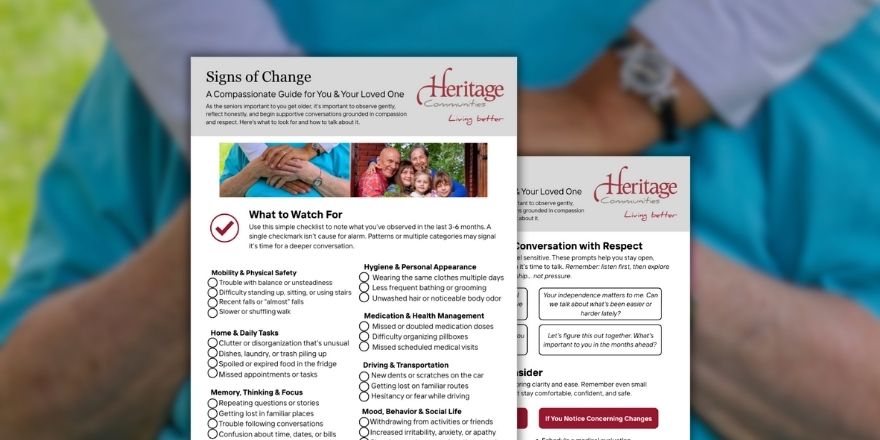
When You Suspect Something’s Changing: A Compassionate Guide for You and Your Parent
If you’re noticing small shifts in your parent’s health, memory, or daily routines, you might be wondering whether you’re overthinking things… or if something really is changing. Download the free PDF checklist to help!
5 Minute Read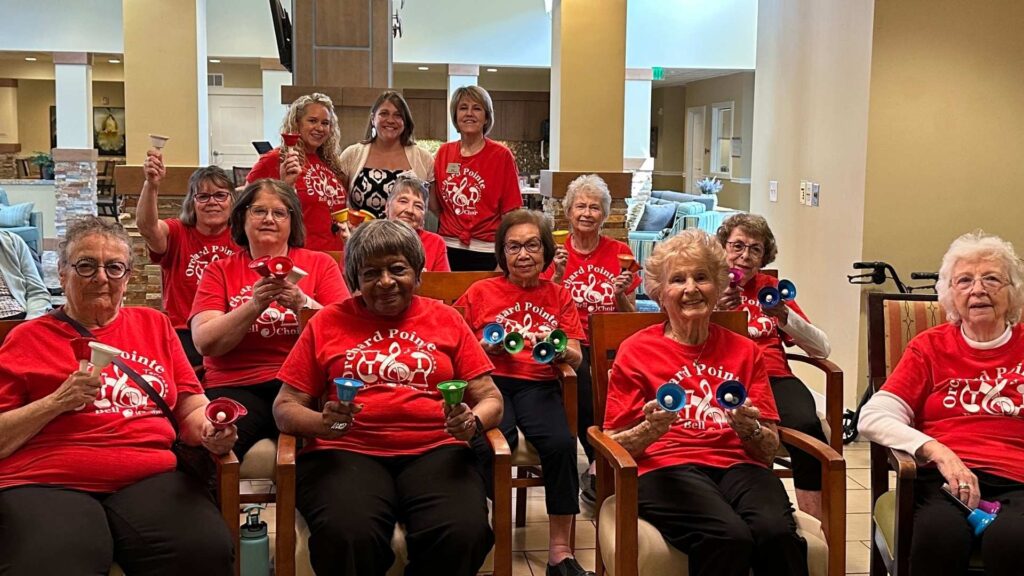
Ringing in the Season: Spotlight on Our Bell Choir at Heritage Communities
The holidays are a busy, fun time in senior living! Across our communities, families and groups are getting ready to celebrate with their families and their Heritage family. We’re glad to share a story from Orchard Pointe at Terrazza (a Heritage Community) that really shows what Living Better together looks like. It’s about the wonderful...
4 Minute Read